






Low Friction Coating
Tribology India offers various coating services like, Moly coating, PTFE coating and Rilsan Coating.
Moly Sulphide Coating
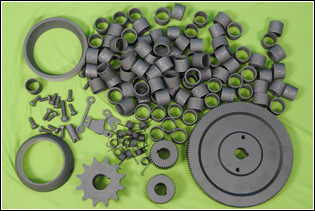
Moly Coatings are unique coatings for excellent wear resistance, reduced frictional torque, easy and frequent dismantling, running in, cleanliness and long-time storage. Moly coating is special bonded solid lubricant containing molybdenum disulphide.
Being a dry film lubricant coating does not pick up dust as compared to Conventional oils and greases. It also has corrosion resistance comparable to conventional plating like zinc, chromium, cadmium, nickel, etc. Typical Applications include Crane pins, tyre moulds/segments, wire drawing parts, articulate joints for earth moving equipment, sliding gate valves, etc.
Moly Coatings are unique coatings for excellent wear resistance, reduced frictional torque, easy and frequent dismantling, running in, cleanliness and long-time storage. Moly coating is special
bonded solid lubricant containing molybdenum disulphide.
Being a dry film lubricant coating does not pick up dust as compared to Conventional oils and greases. It also has corrosion resistance comparable to conventional plating like zinc, chromium, cadmium, nickel, etc. Typical Applications include Crane pins, tyre moulds/segments, wire drawing parts, articulate joints for earth moving equipment, sliding gate valves, etc.
Features:
• Excellent corrosion resistance compared to plating.
• Does not pick up dirt/dust like oils or greases.
• Can withstand high contact loads as compared to conventional oils or greases.
• Useful for running in and noise reduction.
• Helps in easy dismantling.
• Reduces frictional torque.
• Low coefficient of friction.
• Enables storage for long periods especially suitable for marine transportation.
• Superior lubrication
• High Temperature stability
• Corrosion Resistance
• Enhanced performances.
Application and Methods
Moly coatings are applied using various methods, typically involving a preparatory cleaning and surface treatment (like abrasive blasting) to ensure proper adhesion. The main application techniques include:
• Spraying.
• Dipping or Brushing.
• Impingement.
• Chemical Vapor Deposition (CVD).
Fluorocarbon Coating
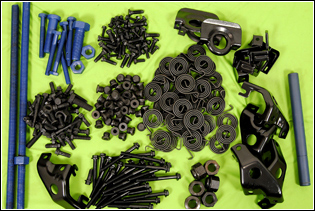
Fluorocarbon Coating is an organic coating consisting of solid lubricant dispersed in an organic binder and dissolved in a specially formulated mixture of solvents.
PTFE is also corrosion-resistant due to the use of a thermally, cured thermosetting synthetic binding material.
PTFE when applied to the substrates resists galling, seizure and fretting and offers corrosion resistance.
- Features:
- It is available in a variety of colors.
- It has excellent adhesion.
- Very low frictional coefficient.
- The effective optimum film thickness is 15-25 microns.
- Corrosion resistance: Between 100- 400 hours salt spray (depending upon the thickness and type) as per ASTM B117
- Working range: 150°C to 350°C depending on the type of coating.
- Applications:
- Construction
- Automotive/Aerospace
- Industrial Machinery
- Household Goods.
- Marine
- Aerospace
- Textiles
- Medical devices
- Electronics.
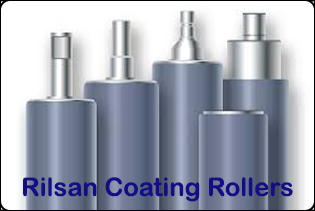
Rilsan® Polyamide Coating
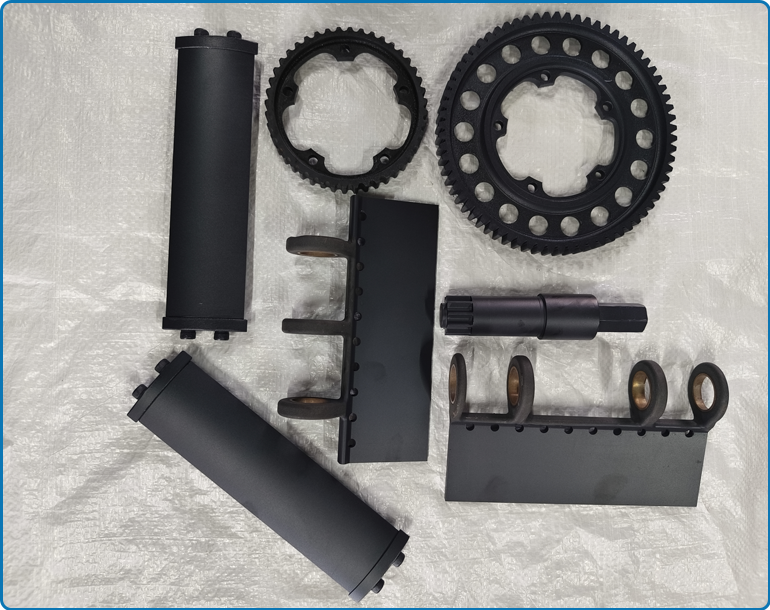
Rilsan® is a unique synthetic thermoplastic coating for excellent corrosion resistance, reduced frictional torque, good impact resistance and good wear resistance.
The nature of the piece to be coated determines which of the various Possible application techniques should be used.
The coating can be applied by Dipping & Spraying. It can be machined to required size.
Typical Applications include Spline and Propeller shafts, Discs in valve industry,printing rollers etc.
Rilsan® is a registered trade mark of ARKEMA France
Features:
• Excellent resistance to corrosion (2000 hours of Salt Spray as per ASTM B 117)
• Good chemical resistance
• Resistance to wear and abrasion
• Good impact resistance
• Electrical insulation
• Low friction surface
• Aesthetic surface finish
• Compatibility with food products
• Good hygienic properties
• Smooth surface, warm to the touch
• Does not promote or support bacterial growth
• Coating thickness varies from 80 to 800 microns